Open access and copyright
Paradigma: Journal of Educational Research promotes open access to scientific knowledge and ensures respect for copyright, intellectual property, and the proper identification of published articles. The policies governing these matters are described below.
I. Open Access Policy
Paradigma: Journal of Educational Research provides free, immediate, and unrestricted access to all of its contents in order to promote the dissemination of scientific knowledge and contribute to the advancement of educational research.
The journal does not charge fees for reading, downloading, consulting, or subscribing to its content.
Paradigma is an active member of AmeliCA, a signatory of the San Francisco Declaration on Research Assessment (DORA), and is indexed in the Latindex Directory, DOAJ and DIALNET promoting open, collaborative, and non-commercial models of scholarly publishing.
II. Copyright and Transfer of Economic Rights
By submitting a manuscript to the journal, authors declare that the work is original, unpublished, exclusively their own, and does not infringe the intellectual property rights of third parties.
By signing the Copyright Transfer Agreement, authors transfer to the Universidad Pedagógica Nacional Francisco Morazán (UPNFM) the economic rights necessary for the reproduction, adaptation, public communication, distribution, preservation, dissemination, and indexing of the article, without territorial limitation and for the duration established by the legislation in force in Honduras.
The transfer of economic rights does not imply the transfer of the authors' moral rights, which, under the Honduran Copyright and Related Rights Law, are inalienable, non-transferable, non-seizable, and imprescriptible.
Authors declare that the manuscript has not been previously published, that the rights to the work have not been transferred to third parties, and that there is no legal impediment to its publication.
Should any claim arise concerning copyright or intellectual property, the authors shall assume full responsibility before third parties.
The opinions, interpretations, and judgments expressed in published articles are the sole responsibility of their authors and do not necessarily reflect the institutional position of the UPNFM, the Instituto de Investigación y Evaluación Educativas y Sociales (INIEES), or the journal's Editorial Team.
III. Publication License
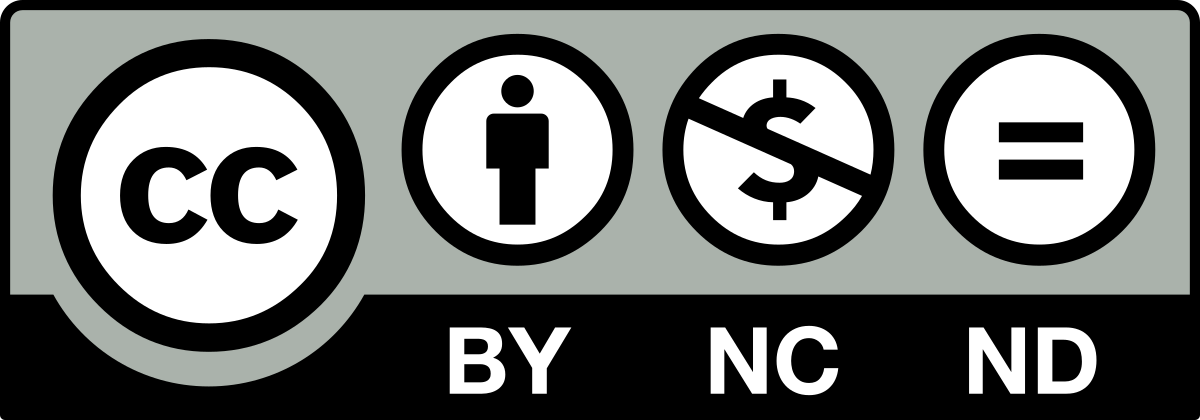
Articles published in Paradigma: Journal of Educational Research are distributed under the Creative Commons Attribution-NonCommercial-NoDerivatives 4.0 International License (CC BY-NC-ND 4.0).
This license allows users to copy, distribute, and share published articles, provided that:
-
appropriate credit is given to the authors and the original source;
-
the content is not used for commercial purposes;
-
no modifications, adaptations, or derivative works are made.
Due to a technical error, some articles published up to and including Issue 48 display a CC BY license. However, the editorial license applicable to those publications is CC BY-NC-ND 4.0.
IV. Permanent Identification of Articles (DOI)
All published articles are assigned a Digital Object Identifier (DOI) to ensure their permanent identification, retrieval, citation, and accessibility within national and international scientific information systems.
The DOI enhances interoperability with scholarly publishing platforms and indexing services, contributing to the preservation and visibility of the journal's academic output.
V. Preservation of the Integrity of the Scholarly Record
When post-publication errors are identified that do not compromise the scientific validity of an article, the journal may publish the corresponding corrections or errata.
When warranted by the nature of the issue, the Editorial Team may issue expressions of concern or retractions in accordance with the recommendations of the Committee on Publication Ethics (COPE).
In the electronic version, corrections will be incorporated whenever permitted by the publishing and indexing platforms. For printed editions, the journal will attach the corresponding errata sheet.
VI. Reuse and Dissemination of Published Content
The journal promotes the responsible dissemination of published articles through institutional repositories, digital libraries, databases, academic networks, and other scholarly information systems, always in accordance with the terms of the publication license and the applicable copyright provisions.
Authors may disseminate the published version of their work provided that the complete bibliographic reference and the DOI assigned by the journal are always included.